
The term 81x86x77 has started appearing in different online discussions, technical documents, and product-related searches, making many people curious about its actual meaning and practical importance. In today’s digital and industrial world, structured numerical combinations are commonly used for product identification, measurements, configurations, inventory tracking, and technical classification. Because of this, understanding what 81x86x77 represents can help both businesses and consumers make more informed decisions when dealing with specifications, products, or technical systems.
Many industries now rely on standardised coding systems to improve communication, reduce mistakes, and maintain operational efficiency. Whether the code relates to dimensions, manufacturing references, engineering details, or digital systems, it serves a purpose that supports organisation and accuracy. This detailed guide will explain everything you need to know about 81x86x77, including possible meanings, industrial applications, advantages, future trends, and common misconceptions. You will also discover practical examples and useful insights that make the topic easier to understand, even if you have no technical background.
What Does 81x86x77 Mean?
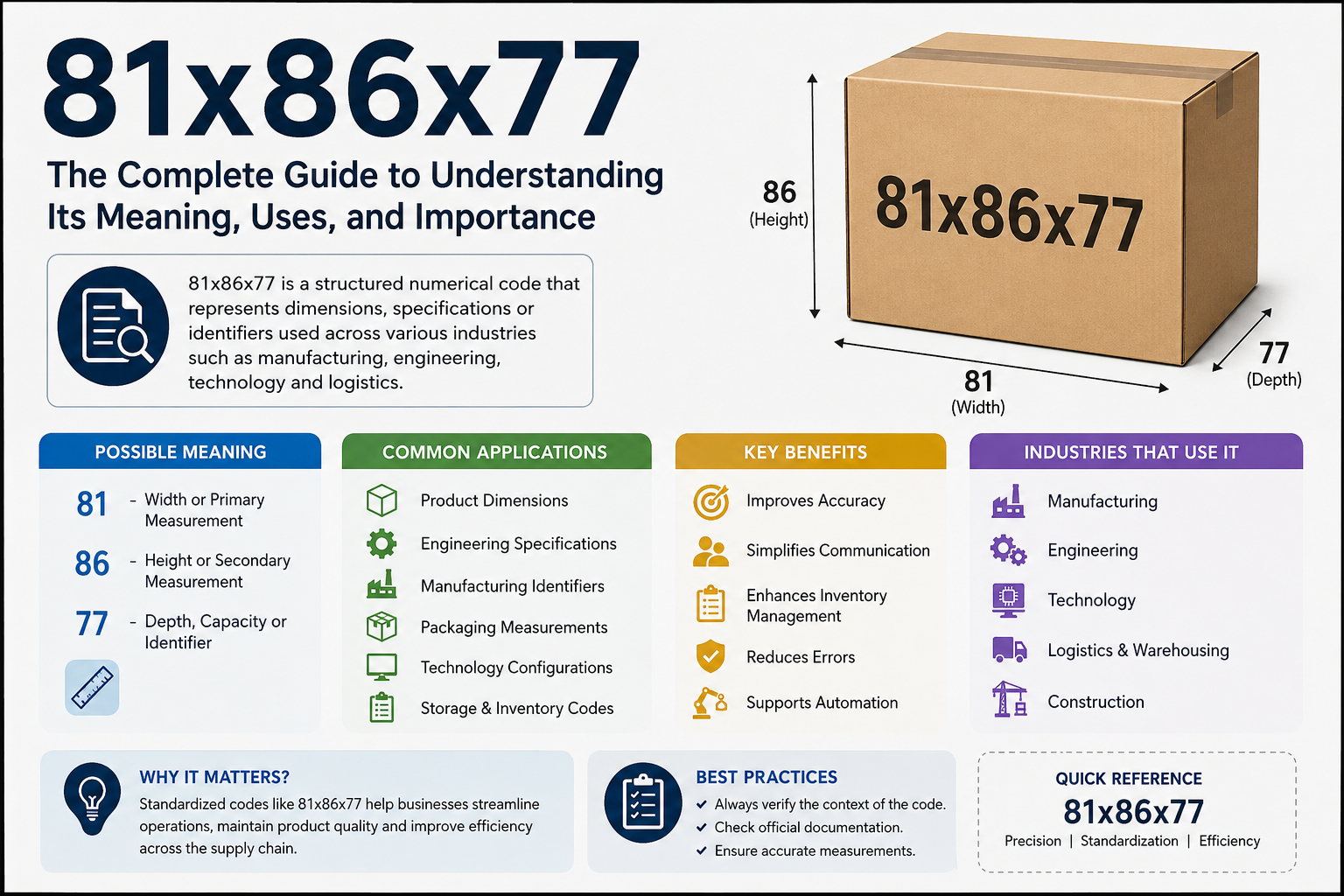
The sequence 81x86x77 is most commonly interpreted as a structured numerical format used to represent measurements, technical specifications, product dimensions, or coded identifiers. Numerical combinations like this are widely used in industries where precision and consistency are essential. Instead of using long descriptive names, companies often use compact numerical systems because they are easier to organise, faster to process, and more efficient for documentation.
In many situations, each number within the sequence may represent a different measurement or category. For example, the first number could indicate width, the second height, and the third depth or capacity. However, the exact meaning always depends on the industry and context in which the code is used. In manufacturing, it may refer to product dimensions, while in technology it could represent system configurations or technical classifications. This flexibility is one of the reasons why codes like 81x86x77 are widely adopted across different sectors.
Common Uses of 81x86x77
- Product dimensions
- Technical configurations
- Engineering references
- Manufacturing identifiers
- Packaging measurements
- Storage classifications
| Sector | Possible Meaning of 81x86x77 |
| Manufacturing | Product measurements |
| Engineering | Component sizing |
| Technology | Configuration reference |
| Logistics | Packaging identifier |
| Warehousing | Inventory classification |
Why Numerical Identification Systems Matter
Modern industries process enormous amounts of information every day. Without structured identification systems, managing products, inventory, and technical specifications would become extremely difficult. Numerical sequences like 81x86x77 help businesses maintain organisation and simplify communication between departments, suppliers, distributors, and customers.
A standardised code eliminates confusion because everyone involved understands the same reference system. This improves efficiency and reduces the risk of costly mistakes. For example, a warehouse employee can quickly locate a product using a coded identifier rather than relying on long descriptions. Similarly, engineers can communicate measurements more accurately using numerical formats instead of vague terminology. As businesses continue moving towards automation and digital management systems, structured identifiers become even more important for operational success.
Benefits of Structured Numerical Systems
- Faster inventory management
- Better communication between teams
- Reduced operational errors
- Easier product tracking
- Improved technical documentation
- Enhanced automation support
These advantages explain why industries worldwide continue to depend on structured coding systems for day-to-day operations.
How 81x86x77 May Be Used in Manufacturing

Manufacturing is one of the industries where structured numerical formats are most valuable. Factories and production facilities handle thousands of components, machines, and materials daily, making accurate identification essential. A code such as 81x86x77 may represent exact dimensions, production specifications, or equipment compatibility details.
Manufacturers use these systems because precision directly affects product quality and operational efficiency. Even small measurement errors can lead to defective products, increased waste, and higher production costs. By assigning clear numerical identifiers to components and products, manufacturers reduce confusion and improve workflow consistency.
For example, a machine component labelled 81x86x77 might indicate specific dimensions required for fitting into a larger assembly system. Workers can quickly identify the correct part without needing lengthy explanations. This speeds up production and minimises errors during installation or maintenance.
Manufacturing Applications
| Application | Purpose |
| Machine parts | Accurate sizing |
| Packaging systems | Dimension tracking |
| Production lines | Product classification |
| Industrial storage | Organised inventory |
| Quality control | Specification verification |
The Role of 81x86x77 in Engineering
Engineering industries depend heavily on exact measurements and standardised systems because accuracy affects performance, safety, and reliability. Numerical sequences such as 81x86x77 can help engineers define dimensions, technical layouts, structural details, or equipment references.
When engineers design machinery, buildings, or industrial systems, they must ensure every component fits precisely within the intended structure. Using standardised identifiers simplifies technical communication and improves project coordination. It also allows teams working in different locations to understand the same specifications without confusion.
Another important advantage is documentation efficiency. Large engineering projects generate massive amounts of technical data. Numerical references help organise this information more effectively and make retrieval faster during inspections, maintenance, or upgrades.
Why Engineers Use Numerical Codes
- Improves measurement accuracy
- Simplifies technical communication
- Reduces interpretation errors
- Supports large-scale projects
- Enhances maintenance processes
Because engineering projects often involve multiple suppliers and contractors, structured identifiers help maintain consistency across all stages of development.
Technology and Digital Applications of 81x86x77
The technology industry frequently relies on numerical formats to classify systems, hardware, and configurations. Codes similar to 81x86x77 are often used in databases, software systems, hardware specifications, and digital inventory platforms.
Technology companies prefer structured systems because they allow computers to process information more efficiently. Instead of relying on long text descriptions, digital systems can quickly identify products and configurations through compact numerical references. This improves performance, speeds up database searches, and supports automation.
For example, a server component or hardware device may use a numerical identifier like 81x86x77 to distinguish it from similar models. Technical support teams can then identify the correct product specifications instantly. This reduces troubleshooting time and improves customer support quality.
Common Technology Uses
- Hardware identification
- Software configuration systems
- Database organisation
- Cloud inventory management
- Digital asset classification
| Technology Area | Possible Use |
| Hardware | Product configuration |
| Databases | Organised indexing |
| Software | System identifiers |
| Networking | Device classification |
| Cloud systems | Asset tracking |
Why People Search for 81x86x77 Online
Online searches for 81x86x77 may happen for several reasons. Some users encounter the term while researching technical products, while others may see it in documentation, product listings, or industrial catalogues. Curiosity also plays a major role because structured numerical sequences naturally raise questions about their purpose and meaning.
People searching for these terms often want simple explanations rather than highly technical definitions. They may be trying to understand measurements, compare products, verify specifications, or identify equipment compatibility. Because many websites fail to provide clear answers, detailed guides become extremely valuable for users seeking reliable information.
Search engines also prioritise informative and user-focused content. Articles that explain technical topics clearly and naturally tend to perform better because they improve user engagement and reduce bounce rates.
Common Search Intent
- Understanding technical codes
- Finding product dimensions
- Verifying specifications
- Comparing configurations
- Learning industry terminology
Providing complete and useful explanations helps users make informed decisions more confidently.
Advantages of Standardised Systems Like 81x86x77
Standardisation creates consistency across industries, which improves communication and operational performance. Structured systems such as 81x86x77 allow businesses to manage large amounts of information efficiently while reducing misunderstandings.
One major benefit is scalability. As companies grow, managing products manually becomes difficult. Numerical identification systems support automation and simplify expansion. Businesses can process inventory faster, maintain accurate records, and improve supply chain coordination.
Another advantage is reliability. Customers, suppliers, and technicians can all reference the same code without confusion. This improves trust and reduces delays caused by incorrect specifications or product mismatches.
Main Benefits
- Better operational efficiency
- Faster inventory processing
- Improved communication
- Reduced human error
- Enhanced automation support
- Easier global standardisation
| Without Standardisation | With Standardisation |
| High error rates | Greater accuracy |
| Slow communication | Faster coordination |
| Difficult scaling | Easier expansion |
| Inventory confusion | Organised management |
Challenges Associated With Numerical Codes
Although numerical systems provide many benefits, they can also create confusion if proper context is missing. A sequence like 81x86x77 may have different meanings depending on the industry, which can lead to misunderstanding among users unfamiliar with technical terminology.
For example, one industry may use the code for measurements while another uses it for configuration references. Without supporting documentation, people may interpret the sequence incorrectly. This highlights the importance of clear communication and detailed technical references.
Another challenge involves training and usability. Employees and customers must understand how to interpret these systems correctly. Companies that fail to provide proper explanations may experience operational delays or customer dissatisfaction.
Common Challenges
- Multiple interpretations
- Lack of context
- Technical misunderstanding
- Industry-specific variations
- Documentation issues
To avoid confusion, businesses should always provide clear specifications alongside numerical identifiers.
Future Trends and the Growing Importance of Structured Codes
As industries continue embracing automation, artificial intelligence, and digital transformation, structured coding systems will become even more essential. Modern technologies rely heavily on accurate data organisation, and identifiers like 81x86x77 support this process effectively.
Future systems may integrate advanced tracking technologies such as smart inventory management, robotics, and cloud-based logistics platforms. These technologies require consistent identification formats to operate efficiently. Structured numerical systems help machines communicate accurately while improving operational reliability.
Experts believe that digital transformation will further increase the demand for standardised coding frameworks across manufacturing, technology, logistics, and engineering industries. Businesses that adapt early may gain competitive advantages through improved efficiency and automation capabilities.
Emerging Trends
- AI-powered logistics
- Smart warehouses
- Automated production systems
- Cloud inventory tracking
- Advanced digital databases
These innovations highlight the long-term importance of structured identification systems in modern industries.
FAQs
Q1. What does 81x86x77 represent?
It usually represents dimensions, measurements, technical configurations, or product identifiers depending on the industry context.
Q2. Is 81x86x77 used in manufacturing?
Yes, manufacturing industries often use similar numerical systems for measurements and component identification.
Q3. Why are numerical identifiers important?
They improve organisation, reduce errors, simplify communication, and support automation systems.
Q4. Can 81x86x77 have different meanings?
Yes, the interpretation changes depending on the industry and application.
Q5. How can I understand technical codes correctly?
Always review the accompanying documentation and understand the context in which the code is being used.
Conclusion
Understanding 81x86x77 becomes much easier when viewed as part of a larger system designed for organisation, precision, and efficiency. Whether used in manufacturing, engineering, logistics, or technology, structured numerical identifiers help industries maintain accuracy and improve communication. As digital transformation continues shaping modern business operations, systems like 81x86x77 will remain increasingly valuable for automation, inventory management, and technical documentation. If you found this guide useful, continue exploring related technical concepts and stay informed about emerging industry trends.
